E-mail seo@sino-purification.com

Time:2026-01-24 13:35:48 Reading volume:
Transformer oil breakdown voltage (BDV) measures the maximum electrical stress that insulating oil can withstand before electrical failure occurs. BDV is primarily affected by moisture, particulate contamination, dissolved gases, oil aging, temperature, and test conditions. Maintaining high BDV is essential for transformer safety, insulation reliability, and service life.
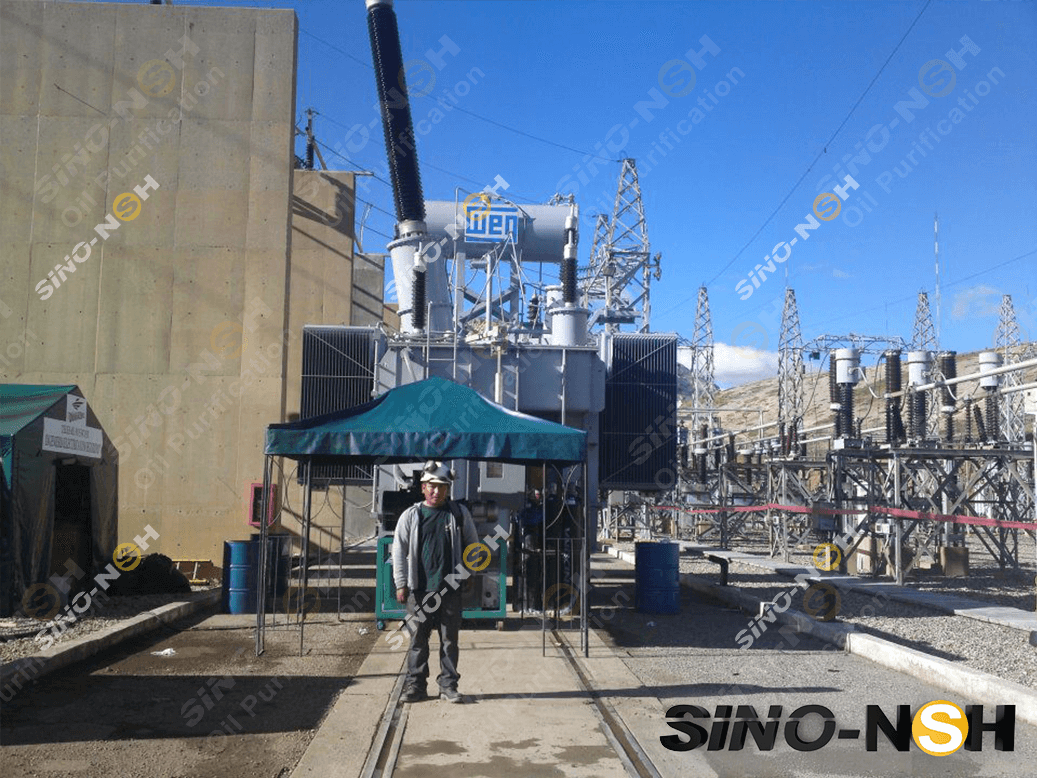
A good breakdown voltage for transformer oil is ≥40 kV for new oil and ≥30 kV for oil in service, measured under standard IEC or ASTM test conditions. Ultra-high-voltage transformers typically require stricter moisture and BDV limits to ensure insulation reliability.
Moisture is the single most critical factor reducing transformer oil breakdown voltage. Even a few parts per million (ppm) of water can significantly lower dielectric strength by forming conductive paths and promoting partial discharge.
Typical moisture limits
Standard transformers: ≤10–15 ppm
UHV transformers: ≤5 ppm
Suspended particles such as cellulose fibers, metal debris, and dust become polarized in an electric field and align to form conductive bridges between electrodes, dramatically reducing breakdown voltage.
Best control method:
High-efficiency filtration (1–5 μm) and regular oil purification.
Dissolved gases (oxygen, nitrogen, and hydrogen) can form microbubbles under high electrical stress. These bubbles have low dielectric strength and often initiate partial discharge and electrical breakdown.
Fault gases such as hydrogen and acetylene further indicate insulation deterioration.
Oil oxidation produces organic acids and sludge, which:
Lower breakdown voltage
Increase moisture absorption
Accelerate solid insulation aging
High acid value is a strong indicator of degraded dielectric performance.
How Operating Conditions Influence Breakdown Voltage
Temperature has a non-linear effect on breakdown voltage:
Moderate heating lowers viscosity, increasing contaminant mobility
High temperatures cause moisture vaporization and bubble formation
BDV typically reaches a minimum between 60–80 °C.
Non-uniform electric fields—caused by sharp edges, poor electrode geometry, or contamination—concentrate electric stress and significantly reduce breakdown voltage compared to uniform field conditions.
Yes. Higher pressure suppresses gas bubble formation, increasing breakdown voltage, especially in oils with high dissolved gas content.
Longer voltage application allows particles and impurities to migrate and accumulate along electric field lines, resulting in time-dependent dielectric breakdown.
Contamination and Compatibility Risks
Yes. Mixing oils from different brands or formulations can cause additive incompatibility, leading to reduced oxidation stability, sludge formation, and lower breakdown voltage.
Best practice: Avoid oil blending unless laboratory compatibility testing confirms safety.
Contaminants at the oil–paper or oil–pressboard interface can trigger surface discharges, accelerating insulation degradation and lowering breakdown voltage.
Influence of Breakdown Voltage Test Conditions
Yes. Breakdown voltage values depend heavily on test conditions.
| Test Parameter | Influence on BDV |
|---|---|
| Electrode shape | Determines electric field uniformity |
| Electrode gap | Larger gaps increase BDV (non-linear) |
| Voltage rise rate | Fast rise inflates BDV results |
| Settling time | Air bubbles lower measured BDV |
Standard voltage rise rate: 2–3 kV/s (IEC / ASTM)
How to Improve and Maintain Transformer Oil Breakdown Voltage
To maintain a high transformer oil breakdown voltage:
Remove moisture using vacuum dehydration
Eliminate particles through fine filtration
Prevent moisture ingress with nitrogen blanketing or silica gel breathers
Monitor oil condition with BDV, moisture, tan δ, and DGA tests
Use antioxidants (e.g., T501) to slow oil oxidation
Quick Reference: Transformer Oil BDV Standards
| Oil Condition | Typical BDV Requirement |
|---|---|
| New oil | ≥40 kV |
| In-service oil | ≥30 kV |
| UHV transformer oil | Higher than standard limits |
Explosion-Proof Oil Purifier Selection Guide: Which Working Conditions Require One?
How to Prevent Rapid Lubricating Oil Degradation in Steel Mills
Can an Oil Purifier Remove Acid? Understanding the Limits of Oil Regeneration
Chemical Industry Oil Purification: How to Choose the Right Oil Purifier
Why Is Coalescing Water Removal More Stable Than Vacuum Dehydration?


