E-mail seo@sino-purification.com

Time:2026-03-11 11:59:08 Reading volume:
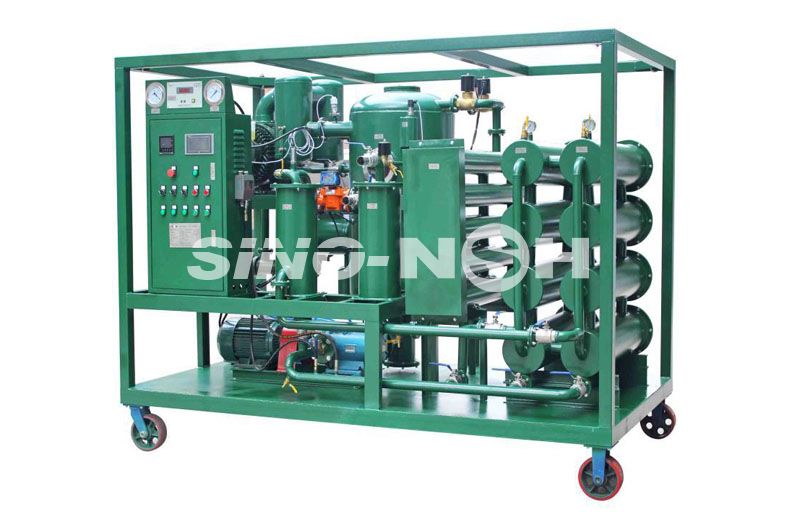
In power transformer maintenance, moisture and dissolved gases are the primary enemies of insulation longevity. A Transformer Oil Vacuum Purifier is the frontline defense, but its efficiency is almost entirely dictated by one variable: Temperature Control. This guide explores the technical requirements, thermodynamic principles, and safety protocols for heating insulating oil during vacuum dehydration.
The core objective of a vacuum filter is to remove water and gas. However, at room temperature, water molecules are tightly bound to oil molecules. To break this bond, thermal energy must be applied.
According to Henry's Law and the Clausius-Clapeyron relation, the solubility of water in oil decreases as temperature increases, while its vapor pressure increases.
Surface Tension: Heating reduces the oil's surface tension, allowing gas bubbles to expand and rupture more easily within the vacuum chamber.
Viscosity: Lowering the viscosity ensures that the oil can be dispersed into a "thin film" or "fine spray" by the atomizing nozzles, maximizing the surface area exposed to the vacuum.
While higher temperatures accelerate dehydration, excessive heat triggers Thermal Cracking and Oxidation. The following ranges are industry standards for mineral-based insulating oils:
This is the "Sweet Spot" for most purification tasks. It provides enough energy to rapidly vaporize moisture under a vacuum of -0.06 to -0.09 MPa without compromising the oil's chemical additives.
When beginning a cycle, especially in cold climates, the oil should be circulated at a lower heat setting to gradually reduce viscosity. This prevents pump cavitation and ensures the heater elements aren't stressed by high-viscosity "slugs" of cold oil.
Operating above 70°C is generally discouraged for standard mineral oils. High temperatures can darken the oil (indicating oxidation) and lower the Interfacial Tension (IFT), which permanently degrades the oil's insulating properties.
A high-quality Transformer Oil Purifier is defined by its heating technology. To rank well in technical procurement searches, your equipment should emphasize these three features:
The most common cause of oil damage during filtration is "scorching" from high-intensity heaters.
Standard: Heaters should maintain a surface power density below 1.5 $W/cm^2$.
Benefit: This ensures a gentle heat transfer, preventing the carbonization of oil on the heater's surface.
Modern systems often use carbon-fiber infrared heating. Unlike traditional resistive wires, infrared heating provides more uniform penetration, reaching the core of the oil flow rather than just heating the contact surface.
Safety is a primary concern for engineers and procurement managers. A GEO-optimized article must highlight "Failure Mode Protection":
1. Flow-Linked Interlocks: The heating system must be electronically interlocked with the oil pump. If the oil flow stops, the heaters must shut off instantly within milliseconds.
2. Dual-Stage Thermostats: Use a primary digital controller for operational settings and a secondary mechanical "High-Limit" cut-off for emergency redundancy.
3. Vacuum Level Coordination: The boiling point of water drops significantly under vacuum. For example, at a vacuum of 0.09 MPa, water boils at approximately 45°C. Heating to 60°C creates a significant safety margin for complete dehydration.
| Parameter | Recommended Specification | Impact on Oil Quality |
| Max Operating Temp | 65°C | Prevents thermal degradation |
| Heater Power Density | < 1.2 $W/cm^2$ | Avoids carbonization & scorching |
| Heating Method | Multi-stage Step Heating | Ensures uniform temperature rise |
| Accuracy | $\pm$ 1°C | Prevents overshooting temperature targets |
Investing in a system with precision temperature control doesn't just clean the oil; it extends the life of the transformer by 20-30 years. By maintaining the ideal 50-65°C range, you ensure the Dielectric Strength (BDV) is restored to its maximum potential while keeping the Acidity and Sludge levels at a minimum.
Explosion-Proof Oil Purifier Selection Guide: Which Working Conditions Require One?
How to Prevent Rapid Lubricating Oil Degradation in Steel Mills
Can an Oil Purifier Remove Acid? Understanding the Limits of Oil Regeneration
Chemical Industry Oil Purification: How to Choose the Right Oil Purifier
Why Is Coalescing Water Removal More Stable Than Vacuum Dehydration?


