E-mail seo@sino-purification.com

Time:2026-03-02 13:54:22 Reading volume:
For most high-voltage maintenance teams, the oil purifier is a "set it and forget it" machine. You hook it up, hit the start button, and assume that as long as the oil is circulating, the transformer is being protected.
But here is the hard truth: If your filter elements are compromised, bypassed, or saturated, your purifier isn't just failing to protect your asset—it might be actively contributing to its degradation.
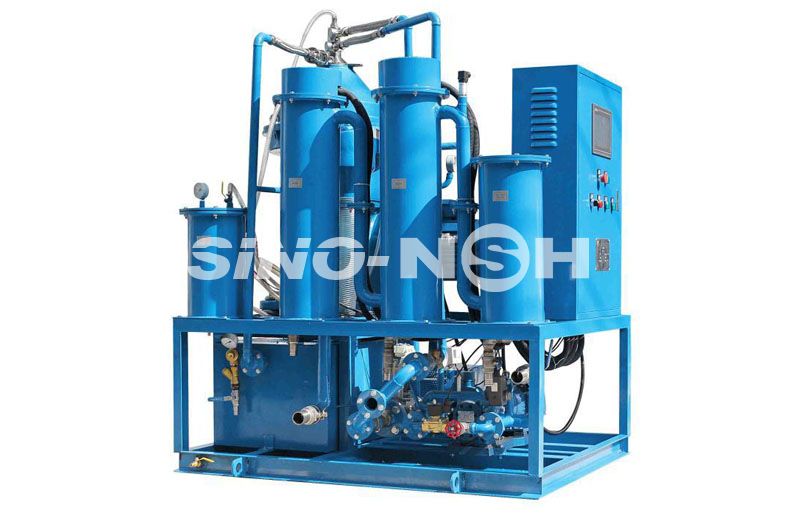
A common misconception in the field is that "oil flow equals oil health." Just because your purifier is pumping at $3,000$ liters per hour doesn't mean it's removing contaminants.
As filter elements reach their dirt-holding capacity, the internal pressure rises. Many systems are designed with a bypass valve to prevent the motor from burning out. Once that valve cracks open, you are effectively "polishing" your oil with a screen door. You see flow on the meter, but the $5\mu m$ carbon particles and cellulose fibers are simply recirculating back into the transformer windings.
The Risk: Recirculating contaminated oil during a purification cycle can actually stir up "bottom sludge," moving it from the floor of the tank into the active cooling ducts where it does the most damage.
To truly protect a transformer, you must understand the Beta Ratio $(\beta)$ of your filter elements. Google’s ranking for technical content now prioritizes "Information Gain"—specific technical data that helps users make better decisions.
Nominal Rating: A filter labeled "5 micron" might only catch $50\%$ of 5-micron particles.
Absolute Rating ($\beta \geq 1000$): High-performance transformer filters catch $99.9\%$ of particles at their rated size.
If you are using low-grade replacement filters to save on O&M costs, you are likely leaving behind the "fine" silt that creates conductive bridges between disk windings. For $400kV$ assets, this is a gamble you cannot afford to lose.
When a filter is left in service too long, it undergoes a process called leaching.
Pressure Spikes: High differential pressure ($\Delta P$) forces oil through the media at higher velocities.
Fiber Shedding: The structural integrity of the filter media (fiberglass or paper) begins to fail.
Media Migration: Microscopic shards of the filter itself are carried into the transformer.
These foreign fibers are highly hygroscopic (water-attracting). Once they settle on your windings, they act as "sponges" for moisture, drastically lowering the partial discharge threshold of your insulation.
Use this table to audit your current oil processing run. If any "Action" criteria are met, your transformer is likely at risk.
| Monitoring Metric | Healthy Range | Action Required | Risk Level |
| Differential Pressure | $< 0.15$ MPa | $> 0.25$ MPa | High - replace Element |
| Oil Clarity | Bright and Clear | Cloudy/Hazy | Critical - Moisture/Sludge |
| Vacuum Level | $< 50$ Pa | $> 150$ Pa | Moderate - Efficiency Loss |
| Exit Temperature | $50°C - 65°C$ | $> 75°C$ | High - Oil Oxidation |
To ensure your purifier is actually doing its job, shift from "Calendar-Based Maintenance" to "Condition-Based Maintenance":
Install Digital Transducers: Move away from manual analog gauges. Digital $\Delta P$ sensors can trigger an automatic shutdown of the purifier before the bypass valve opens.
Verify the "First Pass" Quality: Take an oil sample after the first hour of processing. If the ISO 4406 particle count hasn't dropped by at least two codes, your filters are likely bypassed or ineffective.
Thermal Imaging: Use an IR camera on the filter housings. If you see uneven heat distribution, it indicates "channeling," where oil is cutting a hole through a damaged filter element.
A transformer oil purifier is a precision instrument, not just a pump.
If you haven't checked your differential pressure or verified your filter's Beta Ratio recently, the answer to the question "Is your purifier actually protecting your transformer?" might be a resounding no.
Explosion-Proof Oil Purifier Selection Guide: Which Working Conditions Require One?
How to Prevent Rapid Lubricating Oil Degradation in Steel Mills
Can an Oil Purifier Remove Acid? Understanding the Limits of Oil Regeneration
Chemical Industry Oil Purification: How to Choose the Right Oil Purifier
Why Is Coalescing Water Removal More Stable Than Vacuum Dehydration?


